 (561) 880-4334
Your complete guide to foods, hygiene, what to expect, and when to call us — from Dr. Brandon Zipper and the team at Zipper Orthodontics.
Soreness after bonding is completely normal. Your teeth aren't used to the pressure yet. Here's what's typical and how to feel better faster.
Your teeth will feel tender for 2–4 days after bonding and after each adjustment. Over-the-counter ibuprofen or acetaminophen (follow label dosing) helps. Eating cold, soft foods like yogurt and smoothies also soothes sensitivity.
Brackets and wires can rub the inside of your cheeks and lips until your mouth toughens up — usually within 1–2 weeks. Roll a small piece of orthodontic wax and press it directly over any bracket that's causing irritation.
The first week, eat soft foods only — eggs, pasta, mashed potatoes, soups, smoothies, yogurt, bananas. Your teeth are more sensitive right after bonding. Give them a few days to adjust before going back to a normal diet.
Don't skip brushing because your mouth is sore. Food trapped around brackets causes staining and cavities quickly. Brush gently with a soft toothbrush — being careful doesn't mean skipping. Do it at least after every meal.
After eating, run your tongue along your brackets. A loose bracket will spin freely or feel different. If you find one, call us — don't wait for your next appointment. Loose brackets slow down your treatment.
Most patients feel totally comfortable by week 2. Your mouth adapts quickly. After a few adjustments, you'll barely notice your braces day to day. The soreness after each adjustment gets shorter and milder over time.
These foods can break brackets, bend wires, or get stuck and cause cavities. When in doubt — skip it or cut it small.
There's still plenty of great food on the menu. These are all gentle on your brackets and wires.
Clean teeth move faster. Follow this routine every day to keep your treatment on track and protect your enamel.
Before you brush, swish with water to loosen food from around your brackets and wires. This makes brushing more effective and prevents debris from sitting on your teeth.
Do this even when you can't brush right awayUse a soft-bristled toothbrush at a 45-degree angle. Clean above and below each bracket, along your gumline, and across all tooth surfaces. Spend at least 2 minutes. An electric toothbrush makes this much easier — highly recommended.
Aim for breakfast, lunch, dinner, and bedtimeA small proxy brush (the tiny Christmas-tree-shaped one) reaches the spaces around wires and between brackets that your toothbrush misses. Slide it gently under the wire and between each bracket.
We sent you home with one — find it in your kitUse a floss threader to thread floss under the wire, then slide it between each pair of teeth. Alternatively, a Waterpik (water flosser) is the easiest way to flush food from around brackets and along the gumline. Do it before bed.
A Waterpik is the easiest option with bracesFinish your bedtime routine with a 30-second fluoride rinse. This strengthens enamel around your brackets and protects against the white spots (demineralization) that can appear if hygiene slips during treatment.
ACT or Listerine Total Care both work greatAfter brushing, look in the mirror under good light. Make sure every bracket is fully attached and no wires are sticking out or bent. Catch problems early and call us right away — it's always better to fix something small before it becomes a delay.
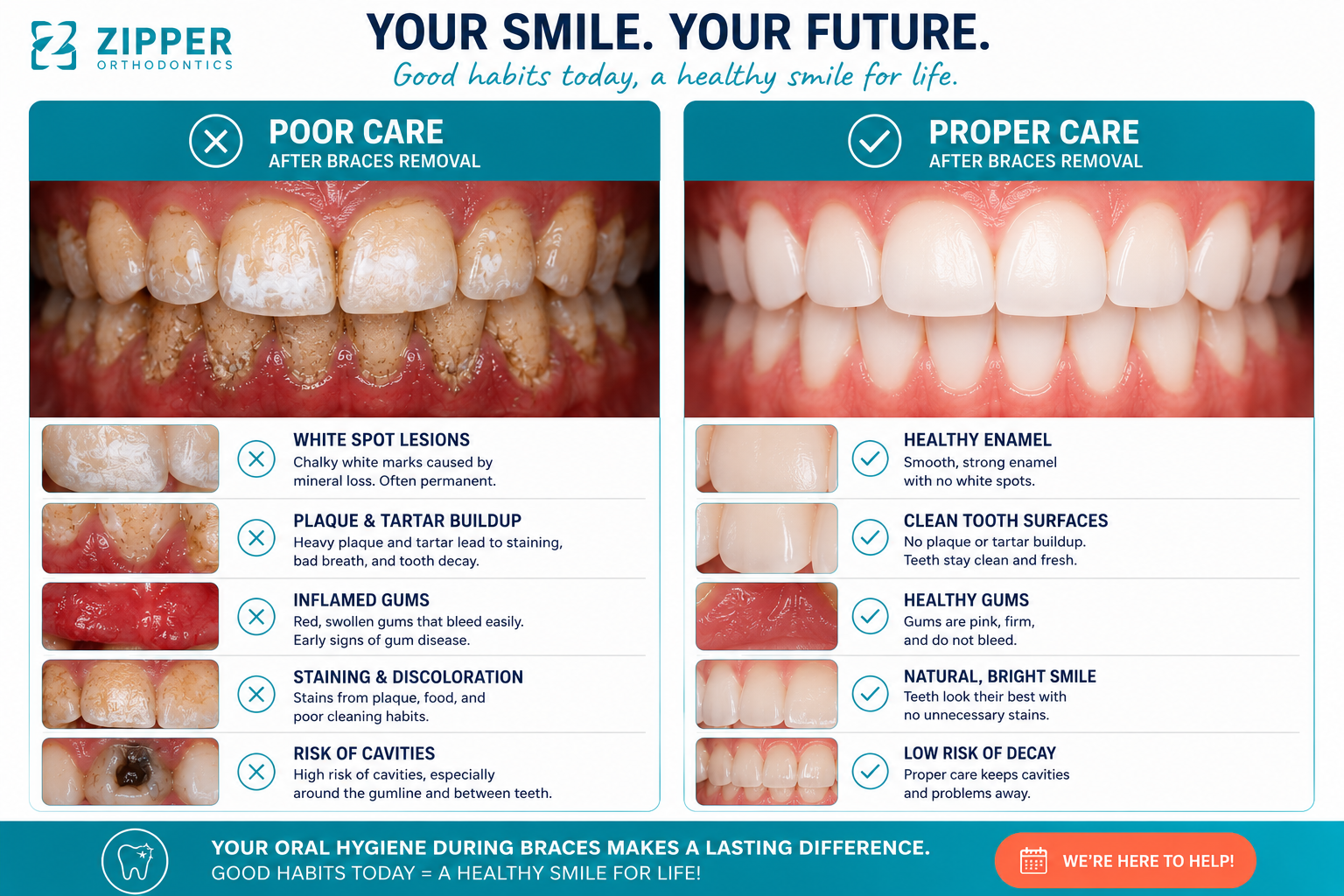
The difference between proper care and poor care during treatment is visible — and often permanent. White spot lesions, plaque buildup, and staining from braces don't reverse when the brackets come off.
Keep these on hand at home — and grab travel-sized versions for your bag or backpack.
Soft bristles only. Hard bristles scratch enamel and irritate gums. Replace every 3 months or sooner if bristles are frayed.
Reaches under wires and between brackets. Available at any drugstore. Use a new one when the bristles wear out.
Makes flossing with a wire possible. Load a strand of floss, thread it under the wire, and floss normally between teeth.
Highly recommended for braces patients. Pulses water to flush debris from around brackets and under wires in seconds.
Press it over any bracket or wire that's irritating your cheek or lip. Change it daily and remove it before eating. You should have some from your bonding appointment.
Ibuprofen (Advil) or acetaminophen (Tylenol) taken as directed helps with soreness after bonding or adjustment appointments. Don't exceed the labeled dose.
Most problems are minor and manageable at home until your appointment. Here's how to handle the most common situations.
If the bracket is still on the wire, cover it with wax to prevent rubbing. If it fell off completely, save it in a small bag. Call our office to schedule a repair — don't wait until your next scheduled appointment.
Use the eraser end of a pencil or a Q-tip to gently tuck the wire back against your tooth. If that doesn't help, place wax over the end. You can also use a clean nail clipper to snip it as a last resort. Call us if it won't stay put.
Completely normal for 2–3 days. Take ibuprofen or acetaminophen as directed, eat soft foods, and rinse with warm salt water (1 teaspoon salt in 8 oz warm water). The discomfort is your teeth moving — a good sign.
Apply orthodontic wax directly to the bracket or wire causing irritation. Rinse with warm salt water to soothe the tissue. In a few weeks your mouth will toughen up and this typically stops being an issue.
The back wire may slide out of its bracket tube. Use clean tweezers or the eraser end of a pencil to gently guide it back in. If you can't do it, call us and come in — this is easy for us to fix in minutes.
If a metal band around your molar feels loose or is moving, call the office right away. Don't try to remove it. Avoid eating on that side until we can see you.
When to call us right away:
A wire is poking your throat or causing severe pain · A bracket falls completely off · You have swallowed a bracket or piece of wire · You're experiencing significant swelling or facial pain.
Call (561) 880-4334Call, text, or message us anytime. Our team is happy to walk you through anything on this page — no question is too small.
Boca Raton office: 2901 Clint Moore Rd #6 · Boynton Beach office: 901 N Congress Ave, Suite 108